
We are living through a moment that resists easy language. Political polarisation has hardened into cultural fracture. Racism is no longer whispered; it is rehearsed, rebranded, and increasingly emboldened in public life. Authoritarian thinking no longer sits at the edges of public debate. It moves through our media, our politics, our streets, and the language of so-called common sense.
Many of us are tired. Tired of explaining. Tired of having to justify our humanity again and again. Tired of being told that what we can see and feel is somehow exaggerated or too risky to name.
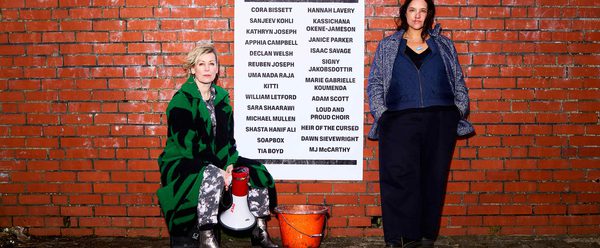
When Cora Bissett and I were commissioned by National Theatre of Scotland to create a one-night event responding to our times, we knew it could not be a night of answers. What it could be was a night of encounter. A space where people could sit with complexity. A space where no one was being instructed how to feel, but no one was being let off the hook either.
The question we kept returning to was not what should be said, but how. How do we speak honestly about harm without reproducing it. How do we acknowledge fear and anger without letting them curdle into despair. How do we stay politically awake without burning ourselves out or turning away.
Mayday emerged from those questions. Not as a manifesto and not as an answer; but as a gathering. A deliberate act of coming together through art at a time when isolation and polarisation are increasingly treated as normal, even inevitable. It is shaped by solidarity and resistance, but also by compassion for artists, for audiences, and for the communities whose lives are too often flattened into headlines or reduced to someone else’s argument.
The cultural shift we are living through is not only political. It is linguistic. Harmful ideas rarely arrive shouting. They often come wrapped in the language of pragmatism, order, and reassurance. They present themselves as reasonable, sensible, necessary. Paying attention to language is not therefore pedantry. It is part of how we protect one another.
As curators, we were clear that art has a particular role to play here. Theatre, dance, music, poetry, comedy, allow us to approach difficult truths without sanding them down. They allow audiences to feel the weight of things, not just understand them intellectually or in the abstract, but to experience them together.

This potential is reflected in the artists involved. From Declan Welsh’s sharp satirical songwriting to Uma Nada-Rajah’s formally disruptive theatre, from Shasta Hanif Ali’s precise and devastating poetry to Sara Shaarawi’s speculative reworking of myth to Kathryn Joseph’s prophetic clarity, the night does not speak in a single voice. It builds in community, but not without challenge.
Allowing personal and community testimony to sit alongside political alienation and global grief; hope by rage, sober warning preceding satirical sketch. And that humour felt essential. Not as a release valve or a distraction, but as a way of telling these truths slant, keeping the room open when despair might shut it down.
Our playwrights along with artists such as Sanjeev Kohli, Tia Boyd, and the punk band Soapbox do not use the comic to soften the moment, but to sharpen it.
Equally important was our commitment to collective voices. Mayday brings together professional artists and community voices and activists. Their presence is grounded in lived experience and in forms of witness too often overlooked in public debate, held in the night within an explicitly artistic frame.
Throughout the process, we kept circling the question of responsibility. What does it mean to make work in this moment? What do we owe each other as artists, as audiences, as citizens? How do we honour histories of resistance without pretending the work is finished or safely behind us?
The night does not tell the audience what to do. It trusts them to sit with the questions raised. It offers examples of how others have chosen to act, through organising, through refusal, through compassion, and leaves space for people to consider what that might mean for them. It trusts the audience to recognise themselves, and to carry questions raised back into their own lives.
The title “Mayday” carries more than one meaning. A distress signal. A call for help. A moment when something has gone wrong and needs attention. But it also gestures toward the possibility of gathering and speaking together. In a time when so much public discourse is designed to divide, the act of coming together feels quietly radical.
This night is not about grand gestures or perfect solutions. It is about collective presence. About refusing isolation. About insisting that solidarity is not an abstract ideal, but a practice that has to be worked at, argued over, and renewed again and again.
In making Mayday, Cora and I were not claiming certainty or anything approaching a complete overview of all crises of the present moment. We were acknowledging the fear, the anger, the grief, and the exhaustion, and choosing not to look away.
Choosing to stay human in a moment when many feel pressured to harden themselves. Choosing to believe that the arts still matter, not as decoration or distraction, but as a place where we can think together, feel together, and begin to imagine the futures we are still reaching for.
On 1 May, Cora Bissett and I look forward to being part of our Mayday audience, listening together and imagining a better future for us all.

Written by Hannah Lavery, April 2026